
Useful content gives readers a clear answer and a way to verify it. The same discipline helps when a search system needs to identify a passage that can stand on its own. This guide explains how to improve the structure, evidence and visual presentation of an article without turning it into a collection of keywords.
Start with the reader's question
Write down the specific question the page should answer. A page about choosing product photography should help someone make that choice, rather than spend its opening paragraphs describing how important ecommerce has become. Put the answer close to the top, then explain the conditions that could change it.
Use Google's people-first content guidance as a quality reference. Useful explanations should come before attempts to satisfy an assumed ranking formula.
Audit the page before rewriting it
Review the title, introduction and first few headings together. They should describe the same problem. Then examine the body in sections:
- Can a reader understand each key answer without reading the surrounding paragraphs?
- Does every important factual claim have a traceable basis?
- Are examples clearly distinguished from measured results?
- Can someone find the practical next step quickly?
Separate structure problems from evidence problems. A useful answer buried in a long introduction needs better placement. A clear answer supported by a broken reference needs source maintenance. An unsupported number needs verification or removal, not more confident phrasing.
Write self-contained answer blocks
Begin a section with its conclusion. Define the subject, explain the recommendation and state the main limitation together. Avoid sentences that depend on an unexplained “this,” “they” or “as above.”
For example, a paragraph explaining product-image consistency should identify what stays fixed: camera angle, lighting direction, background treatment and the relative size of the product. That is more useful than saying the images should look professional.
Keep evidence beside the claim it supports. If a number describes a particular sample, include that scope. If the result is an illustrative scenario, say so. Do not make a hypothetical improvement sound like a measured outcome.
Use visuals to explain the answer
A visual should reduce the work required to understand the text. A comparison can show two layout treatments; a sequence can explain an approval workflow; an annotated example can identify why one hierarchy reads more clearly.
Explore Saharan AI when the article needs a more deliberate visual direction. Its creative workspace and professional creative-production route give teams different ways to approach the visual work. Start with a concrete illustration brief rather than asking for a decorative image that could accompany any article.
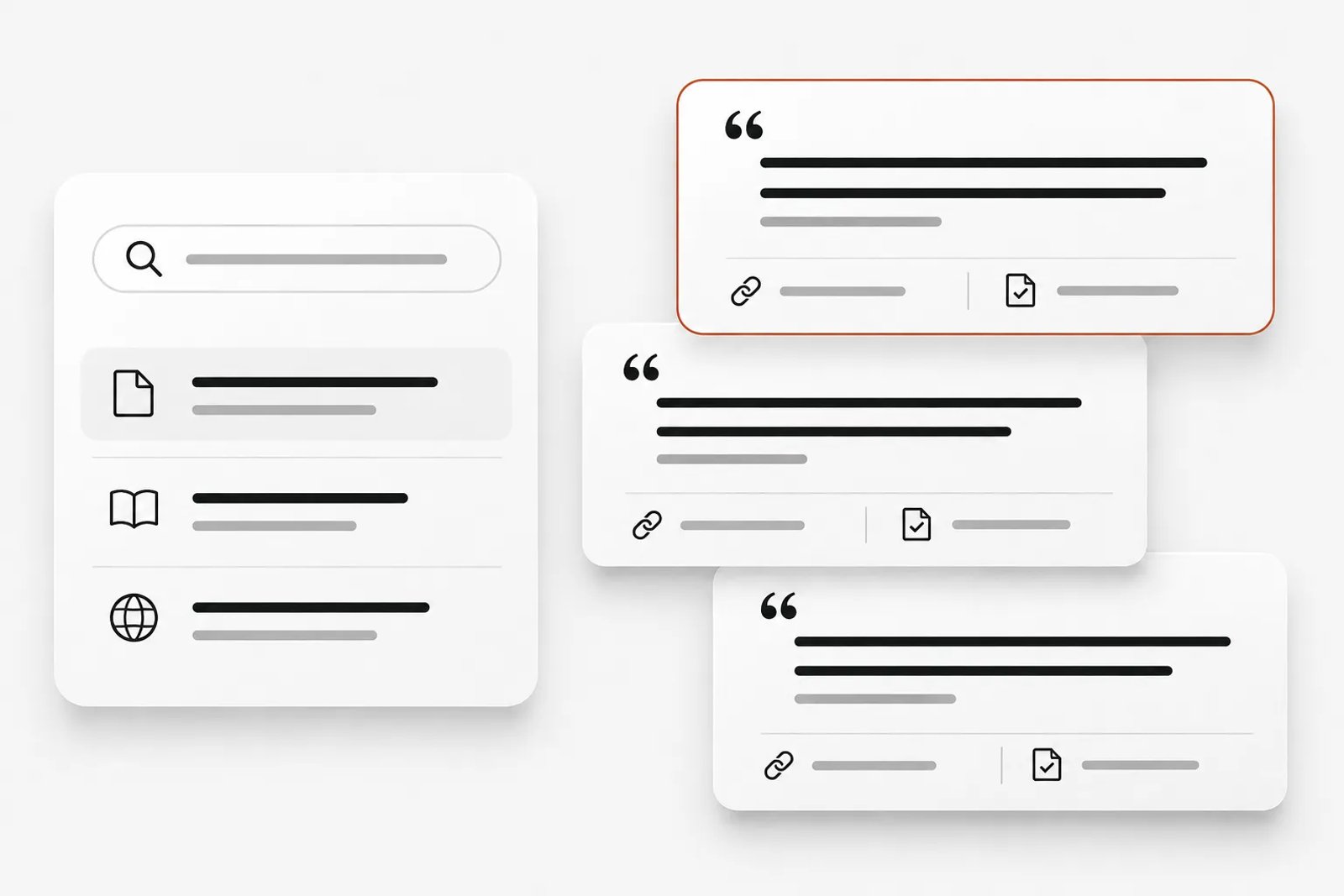
Create a restrained editorial illustration for an article about source quality. Show a clear answer, its supporting evidence and a source reference as three related elements. Use a light neutral background, dark marks and generous empty space. Avoid invented statistics or a realistic search-engine interface.
Keep search expectations realistic
Clear structure does not guarantee a citation. There is no universal paragraph length, source count or review interval that can promise inclusion across search products. Google explains the relationship between ordinary search practices and its AI search features in its documentation for website owners.
Choose a stable set of questions to monitor, record the date and context of each observation, and compare results over time. A single response is not a dependable measure of a whole content program.
A practical publishing workflow
- Write one clear answer to the page's main question.
- Organize supporting material under descriptive headings.
- Verify claims and remove unsupported precision.
- Prepare an illustration brief that explains a real part of the article.
- Review the text and image together for consistency.
- Publish, record the baseline and revisit the page when evidence or product details change.
Frequently asked questions
Should every paragraph contain a link?
No. Link where a source materially helps the reader verify or understand a claim. A small set of relevant references is better than repeated links added for appearance.
Can an image replace the written explanation?
Keep the essential explanation in the article. The image should clarify it, and any meaningful visual information should have an appropriate textual description.
Should I rewrite an existing page or publish a new one?
Improve an existing page when it already addresses the right question but has structural or evidence gaps. Create a new page when the reader's task is meaningfully different.
From an article brief to finished editorial visuals
Saharan AI can support more than the exploration stage. If you want the visual work delivered, provide the article topic, audience, placement and brand requirements through the creative-production route. The finished-creatives option lets you commission finished creatives for your article rather than manage every production step yourself.
Create a visual that earns its place
Take one important section from your next article and turn it into a focused visual brief. Start a project in Saharan AI, explore a direction, and review the result against the explanation before publishing.
Where creative vision is brought to life
Matched in 24h. Delivered by professionals.
50+ AI models. One creative workspace.