
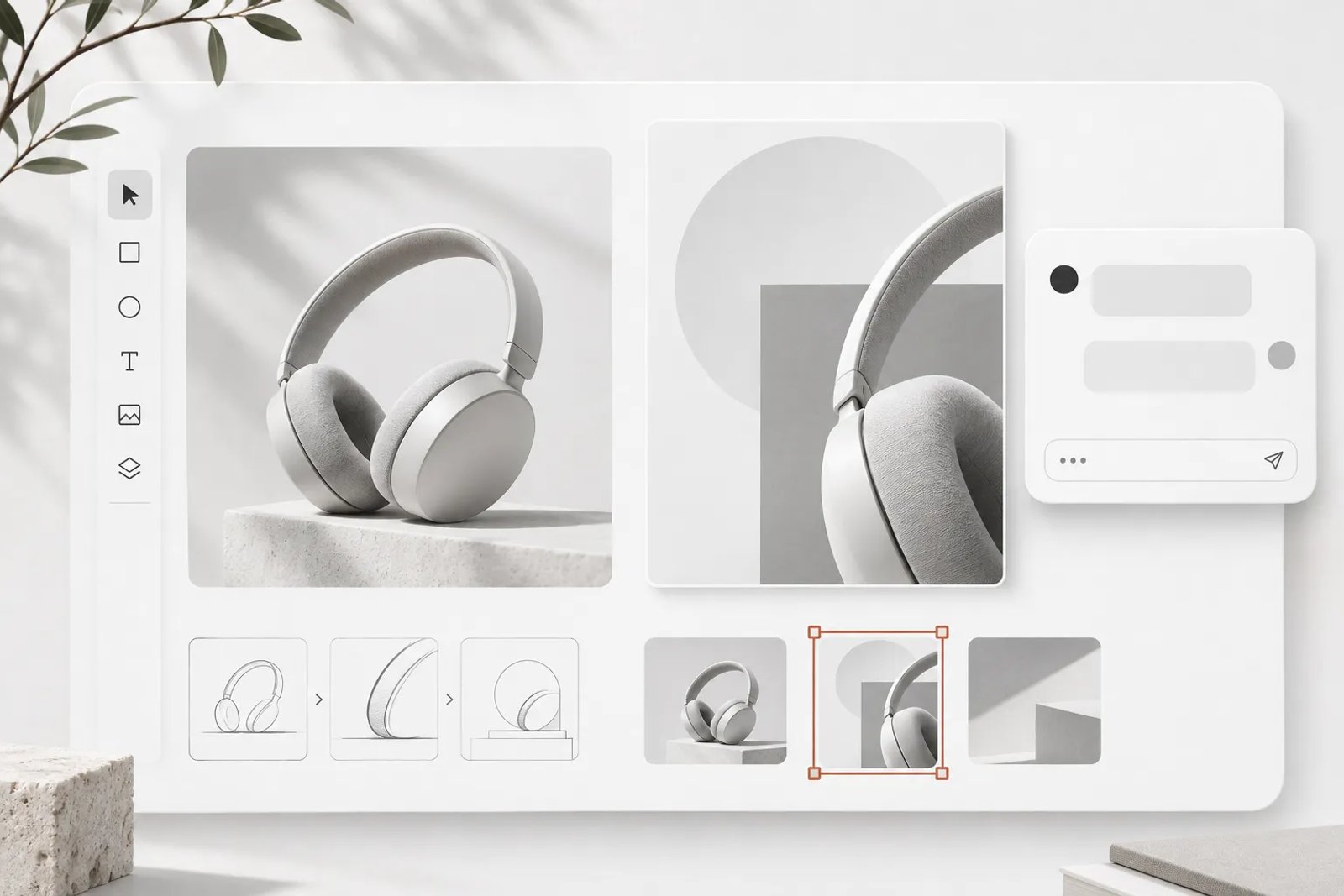
Saharan AI combines AI creative tools with direct delivery of finished creatives. You can create yourself in its workspace or provide a brief and commission the completed work. That choice lets your team decide how much of the production process it wants to handle.
This guide walks through a practical first project, from writing the brief to reviewing a direction. It distinguishes recommended working practices from interface features so you can use the process without assuming that every specialized control is available in your account.
What does Saharan AI offer?
The Saharan AI website presents two routes: creating with AI and commissioning creative production. Its public showcase spans categories such as fashion, advertising, AI film, animation and VFX, branding and ecommerce.
The creative workspace provides an entry point for a new project and a view of recent projects. Think of the brief as the connection between the business problem and the visual work: it tells the creative process what to produce and gives you a basis for evaluating the result.
Choose a clear first project
Start with one deliverable you can assess. A product campaign image, a poster direction or a small visual study is easier to evaluate than an entire brand launch.
Choose something with an identifiable audience and a real destination. You should be able to answer three questions: what is this for, who will see it, and what should they notice first?
Limit the first round to the decisions that matter most. If you are exploring a product image, resolve the subject, lighting and composition before asking for a complete set of formats.
Write the brief before you generate
A strong brief includes the subject, objective, audience, destination, visual direction and constraints. Replace vague adjectives with visible decisions. “Quiet and spacious” becomes more useful when it means a light background, a single subject and room for a short headline.
Create a campaign-image direction for a minimalist skincare product. The audience values clear, understated design. Use soft studio lighting, a light neutral setting and enough open space for a short headline. Preserve the product's recognizable proportions. Avoid extra packaging, invented labels and unrelated decorative objects.
This is an example brief, not a guaranteed output. Review what the project produces against the actual product reference and the available controls.
Prepare the material you want the project to follow
Gather the approved product image, brand palette, logo files and final copy before you begin. Where the current project interface supports reference inputs, use the relevant material and explain what role it plays. A reference for lighting should not be mistaken for a request to copy another company's composition.
Separate mandatory constraints from inspiration. “Keep the packaging silhouette unchanged” is a requirement. “Aim for this kind of open composition” is a directional preference. Making that distinction helps you review the result more precisely.
Open a project and develop a direction
Use the workspace's new-project entry point and supply your focused brief. Start with a limited exploration rather than asking for every possible variation. Keep notes on which direction best serves the objective.
When reviewing options, compare them against the same criteria: subject accuracy, visual hierarchy, audience fit and suitability for the placement. An attractive result can still be the wrong direction for the campaign.
Give feedback that identifies the decision
Instead of “make it better,” describe what should change and what should remain fixed. For example: keep the product angle, reduce the background detail, and leave more space above the subject for the headline.
Prioritize feedback. First fix factual or structural problems, then refine composition, then evaluate finish. Making several unrelated changes together can hide whether the core issue has actually been resolved.
Keep a brand brief you control
Maintain a short external document containing the approved palette, typography direction, image treatment and examples. Bring the relevant instructions into each project. This is a practical consistency method regardless of whether your current workflow includes a dedicated brand-management feature.
For type research, Fonts In Use offers examples of typography in real applications. Study how hierarchy and spacing work in context, then make choices that fit your own brand.
Expand an approved direction into a campaign
Once the first image works, list the other placements the campaign needs. Decide which elements should stay stable and which must adapt to the format.
- Keep the product identity and central message consistent.
- Adapt the crop and spacing to the destination.
- Review longer headlines separately from short ones.
- Check the full set together before approving individual files.
Do not assume a resized version will preserve the intended hierarchy. A portrait placement may need a different arrangement from a landscape header even when both use the same visual idea.
Review the work before delivery
Check spelling, product details, image artifacts and the relationship between text and background. Use the W3C contrast guidance when evaluating readable text.
Confirm the output options available in the project and compare them with the destination's requirements. Keep a clear record of the approved version and avoid ambiguous filenames such as “final-final-new.”
When to submit a creative-production brief
Consider the production route when the project needs a coordinated team, a broader creative concept or specialist finishing. Describe the desired outcome, the deliverables, existing material and how decisions will be approved.
The more specific the brief, the easier it is to discuss scope. Include what is already decided and what you want the creative team to explore. A production request should establish responsibilities as well as visual preferences.
Common first-project mistakes
- Starting with a visual style before identifying the audience and message.
- Asking for too many deliverables before approving one direction.
- Leaving factual product details out of the brief.
- Giving contradictory feedback without identifying the priority.
- Assuming a feature, output format or commercial term without checking the current product information.
Frequently asked questions
Is Saharan AI only for product images?
No. The public site presents work across several creative disciplines, including branding, advertising, film and ecommerce. Choose a project route and scope appropriate to the outcome you need.
Do I have to commission a team?
The site also provides a create-with-AI route for beginning a project yourself. Creative production is a separate path for work where professional involvement is appropriate.
Will the tool automatically remember all my brand rules?
Keep an explicit brand brief and provide the relevant instructions in your project. Do not rely on unconfirmed memory behavior for important production requirements.
Where should I check pricing and commercial terms?
Review the current information shown in the product and applicable service terms before committing to a workflow. This guide does not assign prices, credit allowances or licensing terms that have not been confirmed.
What is the best first step?
Choose one real deliverable, write a concise brief and define how you will judge the result. A focused project teaches you more than an open-ended request for many unrelated ideas.
The difference: AI tools and finished creatives
Saharan AI goes beyond giving you tools to operate: it can also provide finished creatives directly. You can take the hands-on route when you want to create yourself, or commission the completed creative work when your team needs the outcome delivered. Define the required assets, placements and acceptance criteria in the brief so “finished” has a concrete meaning for the project.
Bring your first brief to Saharan AI
You do not need a complete campaign plan to begin. Start with one clear visual problem and open the Saharan AI workspace. Develop a direction, review it carefully and build from the decisions that work.
Where creative vision is brought to life
Matched in 24h. Delivered by professionals.
50+ AI models. One creative workspace.